

A 2026 benchmark found that server-side rendering cut Time to Interactive by 62.3% and Largest Contentful Paint by 58.7% versus client-side rendering, and the gap widened as pages got larger (2026 SSR vs CSR benchmark). That's the starting point here. For a small business, the question isn't which approach is cooler, it's which one gets your page visible, crawlable, and usable before a visitor bounces.
| Dimension | Server Side Rendering | Client Side Rendering |
|---|---|---|
| First impression | Sends finished HTML early, so content can appear fast | Sends a shell first, so the browser has to do more work |
| SEO | Safer for crawlable content and metadata | Riskier, because meaningful content depends more on JavaScript |
| Interactivity | Needs hydration before everything responds | Becomes interactive after the app finishes booting |
| Hosting load | More work on the server per request | More work on the visitor's device |
| Team complexity | More moving parts, caching, and runtime concerns | Simpler to ship as a frontend bundle |
What SSR and CSR Actually Mean in Plain English
SSR means the server builds the page before the browser sees it. The browser gets complete HTML, so the first useful content can appear right away. CSR means the server sends a thin shell plus JavaScript, and the browser assembles the page after the scripts load and run.
That difference sounds small. It isn't.
The real split is where the work happens
With SSR, your server does the heavy lifting, then hands the visitor a page that already looks finished. With CSR, the visitor's device does more of that work after the request lands. The visual result can look identical once everything settles, but the path to that result is very different.
Practical rule: if the page must be understandable before JavaScript finishes, SSR or pre-rendering is the safer default.
The cleanest mental model is this. SSR is a finished meal delivered to the table. CSR is a meal kit the browser has to cook. If your site is a public marketing page, the meal should already be plated. If your site is an authenticated app where users expect app-like behavior, the kit makes more sense.
The reason this matters is visible in web performance guidance too. Server-rendered HTML can produce a fast first contentful paint because the browser doesn't have to wait for a big script bundle before it can show something on screen (web.dev rendering guidance). CSR shifts more work into the browser, which can stretch the path to visible content when JavaScript gets heavy. That's why the same stack can feel fine on a laptop and sluggish on a mid-range phone.
How Each Approach Loads a Page Step by Step
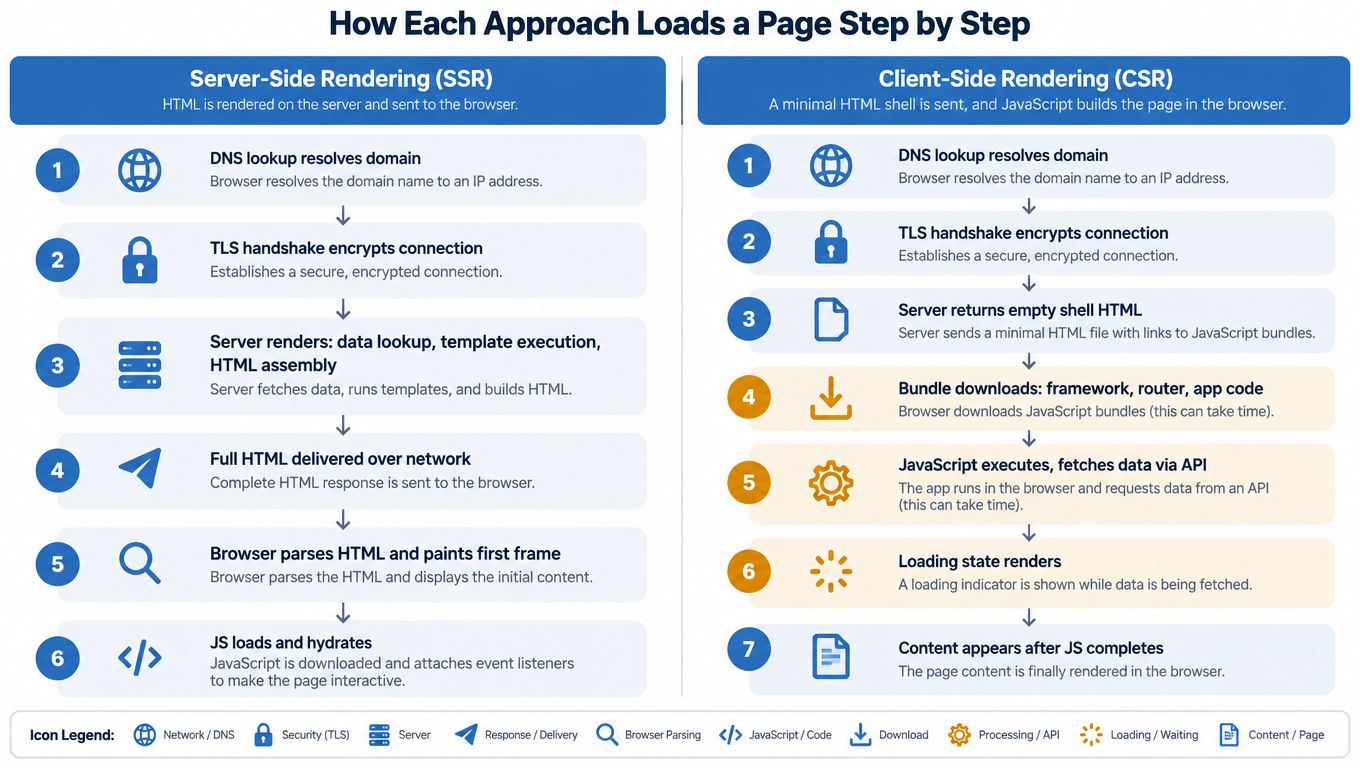
SSR front-loads content, CSR front-loads code
SSR starts with the server. The browser requests the page, receives ready HTML, parses it, and can paint real content before the rest of the JavaScript finishes. That usually helps FCP and LCP, because the user is not waiting for a full app bundle before seeing anything useful. For pages meant to inform, persuade, or convert, that early visibility matters.
CSR takes the opposite path. The server sends a lighter shell, then the browser downloads the app code, runs it, and builds the page on the client. The backend work is simpler, but the delay moves into the browser. The first screen may appear faster in theory, yet the user still waits for scripts to finish before the page becomes meaningful.
The step-by-step difference shows up in the metrics that matter. In the benchmark cited above, SSR came out ahead on TTI and LCP, and the gap widened as pages got larger (same benchmark). Do not read that as a universal win for every site. Read it as a warning that CSR gets more expensive as page weight and complexity rise.
The sequence tells you which metric moves
- TTFB often rises with SSR because the server does real rendering work before it responds.
- FCP usually improves with SSR because the browser gets visible HTML sooner.
- LCP usually improves with SSR for the same reason, especially on content-heavy pages.
- TTI can lag behind visible paint in both models, but CSR usually carries more bundle execution cost before the page becomes usable.
- TBT often gets worse in CSR when the main thread is busy parsing and executing scripts.
A short page can hide these differences. A content-heavy page cannot. Once the DOM grows and the JavaScript bundle gets heavier, CSR pushes more work onto the browser right when the visitor is trying to read or act.
Run a structured performance audit before you choose a rendering strategy. A checklist like the one in website speed optimization tools helps you measure the slow parts first, instead of guessing which rendering model will fix them.
Hydration sits between those two timelines, and it is where many teams get caught off guard. The page looks ready, but the browser still has to wire up interactivity.
SSR vs CSR Across the Metrics That Matter
| Dimension | Server Side Rendering | Client Side Rendering |
|---|---|---|
| SEO crawlability | Ships usable HTML immediately, which is safer for indexing and metadata | Depends more on JavaScript execution before content exists |
| Perceived speed | Usually stronger on first meaningful paint and content visibility | Can feel fast on the very first shell, then stalls before content appears |
| Interactivity | Requires hydration, so a visible page can still be temporarily inert | Once booted, interactions are native to the app model |
| Hosting cost | Server does more work per request | Server does less rendering work and shifts load to the browser |
| Developer complexity | More moving parts, more caching decisions, more runtime concerns | Simpler mental model for app-style frontends |
| Resilience | More likely to leave readable content if JavaScript fails | Much more dependent on JavaScript success |
| Debuggability | Easier to inspect meaningful markup early | Easier to ship a clean static bundle |
SSR generally wins on the metrics that support discovery, early content visibility, and conversion. CSR wins on simplicity of delivery and app-like responsiveness after the app has already loaded. That's the trade.
One thing teams ignore too often is the failure mode. If JavaScript breaks, SSR can still leave the user with readable content. CSR can leave them staring at a blank shell or a broken interface. For a public site, that alone should push you away from pure CSR unless you have a very specific reason to use it.
The other forgotten dimension is operational cost. Google's rendering guidance notes that SSR can improve speed and SEO, but it also comes with more complex implementation and server-side concerns (Google rendering guidance). That complexity isn't theoretical, it shows up in caching, invalidation, and how much CPU each request consumes.
My rule of thumb: if a stranger needs to find the page in search, SSR or static generation should be your default. If only logged-in users see it, CSR becomes a real option.
You'll notice I haven't called CSR “bad.” It isn't. It's just the wrong default for most public, revenue-facing pages.
Hydration, Caching, and the Hidden Tradeoffs
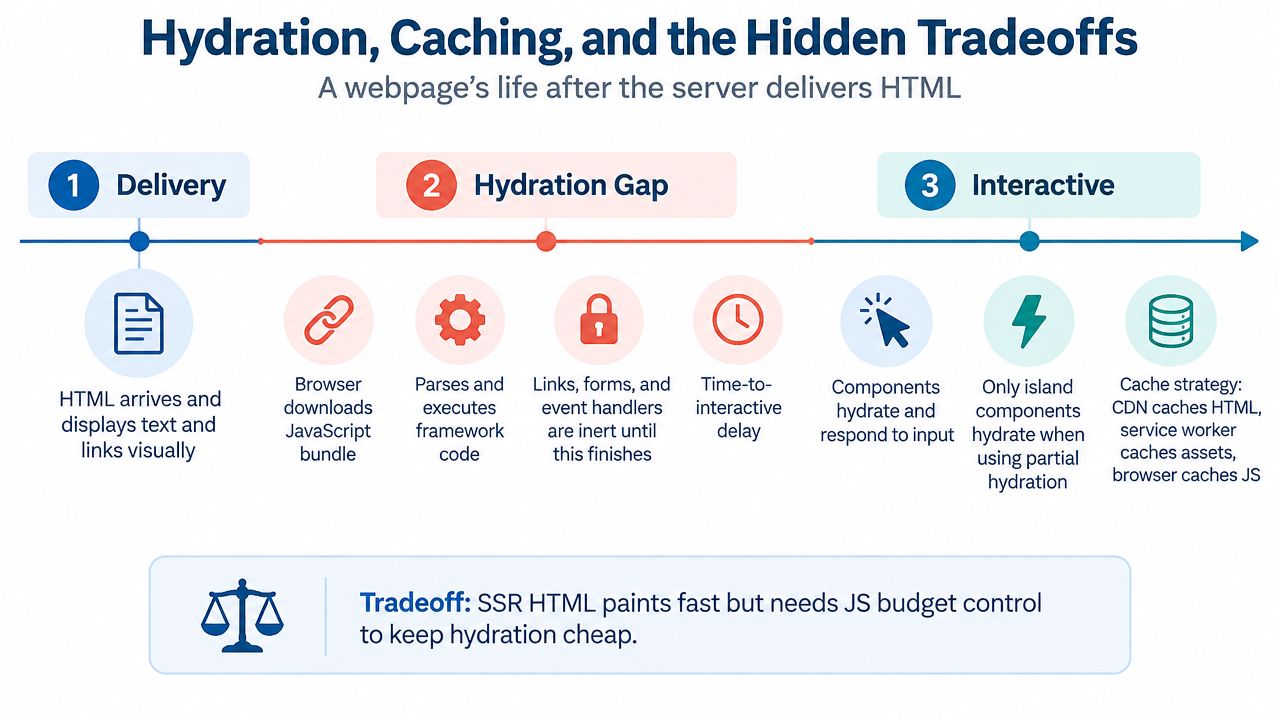
Hydration is the gap nobody budgets for
Hydration is when the browser takes SSR-generated HTML and attaches the JavaScript behavior behind it. Until that process finishes, links, forms, and buttons may look ready while doing nothing. A page can therefore score well on LCP and still frustrate customers who try to interact with it.
Measure this gap directly. Fast HTML does not compensate for bloated JavaScript. The page needs to respond when a visitor clicks, submits, or opens a control, not merely appear complete.
The fix is structural. Selective hydration, partial hydration, resumability, and islands architecture reduce how much of the page must start at once. Less JavaScript on the critical path shortens the delay between “it looks loaded” and “it works.” For a small business, that can improve the path from landing page to enquiry without adding unnecessary client-side code.
Caching decides how expensive your choice becomes
SSR usually pairs well with CDN caching for full HTML, along with invalidation methods such as stale-while-revalidate when the content can tolerate brief staleness. CSR depends more on cached JavaScript assets and client-side data requests. Both approaches can be fast, but they cache different resources in different places.
Cache design should be part of the rendering decision, not an afterthought. Aggressive personalization makes SSR pages harder to cache. Oversized CSR bundles reduce server work while making every visitor download and execute more JavaScript. Track cache-hit behavior, HTML generation time, bundle size, and the delay before key controls respond.
Keep the rule simple: cache HTML aggressively when the page is mostly public, cache data carefully when freshness matters, and keep hydration small no matter which model you pick.
A hybrid setup is the practical choice for many production sites. SSR or static generation delivers the first useful page, while the client hydrates only the interactive islands that need behavior. You get fast content without turning the entire page into a JavaScript project.
MD TECH TEAM's hosting and performance work fits into this kind of setup when a small business needs render strategy, caching, and deployment to stay aligned instead of becoming separate decisions. The point is to match the stack to the page's job, then measure whether that choice improves response time and customer action.
Matching the Approach to Your Business Type
A local service business rarely needs a complex frontend. With a few core pages, a contact form, and a call button, use static or pre-rendered HTML. Visitors get useful content quickly, search engines can read the metadata, and your team can focus on messaging and conversion instead of maintaining unnecessary framework complexity.
A lead-generation site has a stronger SEO requirement. If informational keywords bring in prospects, deliver meaningful HTML in the initial response. SSR or static generation with on-demand revalidation usually fits better than a client-rendered shell because crawlable content, publishing speed, and landing-page performance directly affect acquisition.
Business model should drive the rendering model
E-commerce needs a split approach. Product and category pages should generally use server rendering or pre-rendering to support search visibility and a fast shopping experience. Cart, checkout, and account screens can use more client-side behavior because their purpose is task completion rather than discovery. Measure both page speed and completed purchases before applying one rendering model across the store.
A logged-in SaaS dashboard is the clearest CSR use case. Users are already inside the application, so public indexability has little value. Fast interactions matter more, especially for data-dense interfaces with frequent updates and substantial client-side state. Spend complexity on the workflow users repeat, not on markup search engines will never need to crawl.
| Business Type | Recommended Default | Key Driver | Watch Out For |
|---|---|---|---|
| Local service site | Static or pre-rendered HTML | Fast public load and simple maintenance | Don't overbuild a tiny site |
| Lead-gen site | SSR or static generation with revalidation | SEO and crawlable content | Avoid bloated hydration |
| E-commerce store | SSR for product and category pages, CSR for checkout | Organic discovery and conversion | Don't force one model everywhere |
| SaaS dashboard | CSR, or SSR with aggressive client caching | Logged-in app speed | Don't optimize for crawlability that you don't need |
Your content management setup also affects the decision. A CMS-heavy site usually benefits from server-rendered or pre-rendered public pages, giving editors predictable publishing behavior while preserving search visibility. If publishing requires complicated frontend changes, the stack is working against the business.
Choose based on the page's job: who must see it first, what action should follow, and how much hosting and development complexity that action can support. That decision connects rendering to SEO, operating cost, maintenance effort, and conversion rather than treating SSR and CSR as a performance-only contest.
A Clear Recommendation and a Pre-Build Checklist
Here's the direct answer. If the page needs to rank in Google and load fast on a phone over 4G, start with SSR or static generation, then hydrate only the parts that need interactivity. Pure CSR is the wrong default for any public-facing, SEO-dependent site in 2026.
That doesn't mean CSR is obsolete. It means CSR belongs where the app is already authenticated, highly interactive, or hidden behind a login. In those cases, you care more about fast repeat actions and less about crawlable markup. If the page is a dashboard, a collaboration surface, or a private workflow, CSR can be the better fit.
Use this checklist before you pick the stack
- Traffic source mix: If organic search matters, favor server-rendered HTML.
- Page count: Small sites should stay simple, large content sites need stronger rendering discipline.
- Update frequency: If content changes often, plan your caching and revalidation now.
- JavaScript skill on the team: If the team is weaker on frontend complexity, avoid a stack that requires delicate hydration work everywhere.
- Hosting budget: If server CPU is tight, don't pretend SSR is free.
- Core Web Vitals baseline: Measure what's already slow before you change architecture.
- Crawl budget sensitivity: If search visibility matters, make the first response useful.
- Personalization depth: The more customized the page, the harder caching becomes.
- Third-party tag load: Heavy scripts can destroy the benefit of a clean rendering strategy.
- Rollback plan: If the chosen approach hurts conversion or performance, you need a clean escape route.
The stack should score well on the things that affect revenue, not on what's trending in developer conversations.
If you want a narrow recommendation, here it is. Public site, use SSR or static generation. Private app, use CSR where it helps the workflow. Mixed site, split the responsibilities instead of forcing one model onto everything.
If you want a rendering choice tied to SEO, hosting, and conversion instead of framework fashion, talk to MD TECH TEAM. They build and support small-business websites, hosting, SEO, and optimization work that can help you pick the right rendering model before you lock in the stack.


